Mosaic — Danfoss Design System
Co-initiated and led the design side of Danfoss's official design system, now used across multiple product teams with 100+ accessible components.
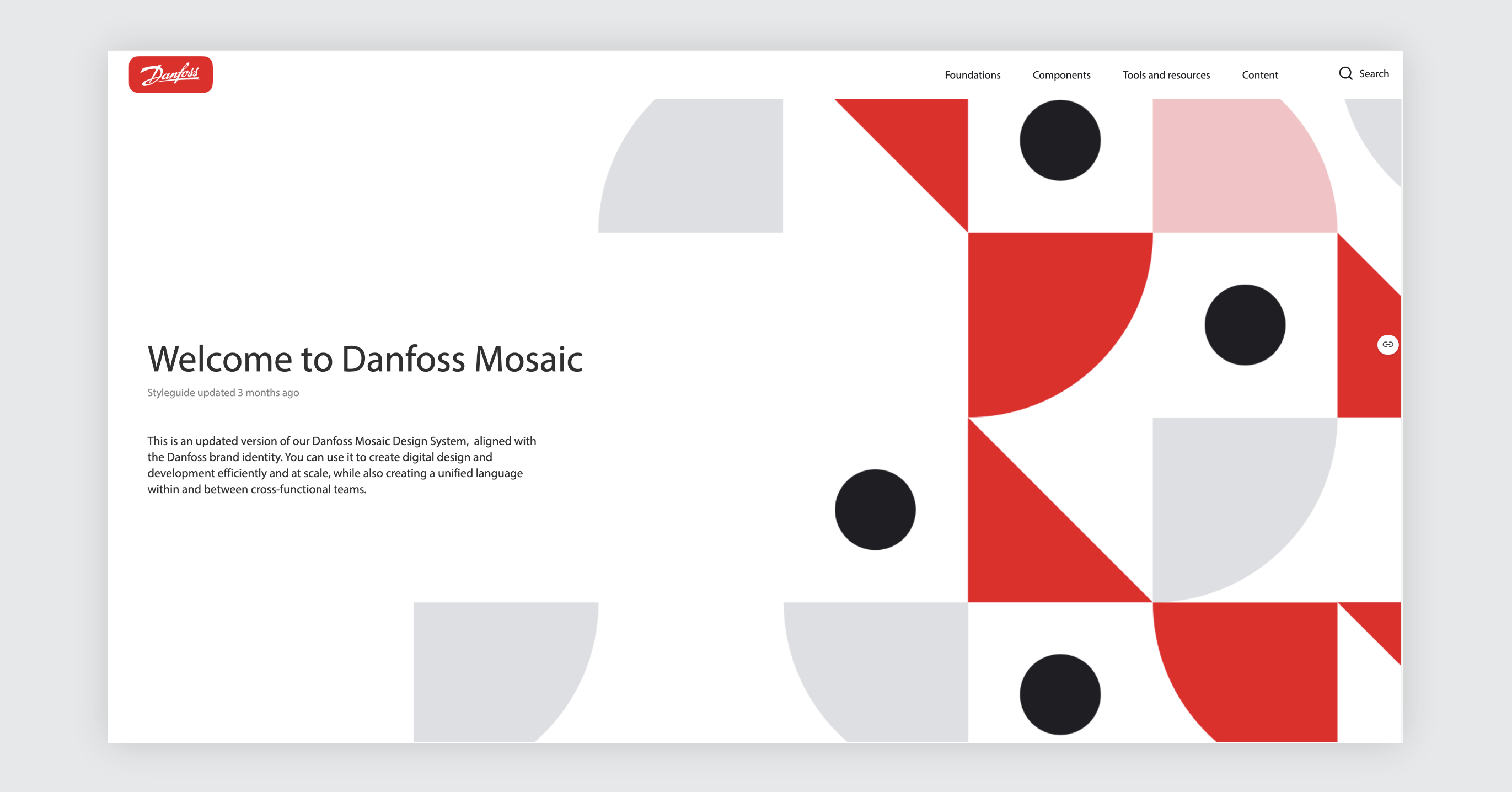
Mosaic is now the official Danfoss design system — over 100 components, used across multiple product teams. I co-initiated it in 2020 with a developer and a business stakeholder, led the design side in the early years, and have been part of its evolution ever since. This case study is about how a small grassroots effort became company-wide infrastructure.
When I joined the Digital Experience Design team at Danfoss, one thing stood out quickly: the digital landscape was fragmented. Different products were built by different teams at different times, each with their own visual language, component patterns, and interaction models. Nothing was deliberately inconsistent — it just happened organically over years of parallel development.
I’d seen this before and knew a design system could help. So while working on the Product Store, I started building a small, local design system for my own projects. That local system eventually became the prototype for something much bigger.
The challenge
The problem wasn’t that people were doing bad work. The problem was that good work was being duplicated and disconnected. Teams were solving the same UI problems independently, building their own buttons, dropdowns, and tables from scratch. Every new project started at zero. And for users moving between Danfoss digital products, the experience felt inconsistent — different layouts, different interaction patterns, different visual treatments of the same things.
Convincing a large industrial organization that a design system is worth investing in is not straightforward. It’s not a customer-facing product. The value is indirect — faster delivery, fewer inconsistencies, better accessibility — and those benefits only become visible over time.
The solution
We started small. Three people — me as the designer, one developer, and one person from the business side. That combination turned out to be exactly right, because a design system that only designers believe in doesn’t survive.
The first step was an inventory: mapping what existed across products, identifying patterns, and finding where the biggest inconsistencies lived. From there, we built a proof of concept — a small set of foundational components with clear principles and usage guidelines.
I proposed the name Mosaic. Not after the old Mosaic browser — after real mosaic, the craft of creating something coherent from many individual pieces. That felt like a good metaphor for what we were trying to do.
We presented the proof of concept to the leadership team. The key was framing it not as a UI library but as a shared foundation — something that would change how teams build, not just how things look. That framing mattered. It shifted the conversation from “nice design project” to “strategic infrastructure.”
Once approved, Mosaic grew steadily. In the first months, I led the design side — defining component structure, naming conventions, usage principles, and documentation standards. Eventually I handed that role to a dedicated design system designer. I became a user of the system instead — shaping it indirectly through feedback from my own product work. But I kept evangelising. Driving the digital design community, joining regular sessions to support teams going through adoption, making the case internally whenever it needed making. That side of the work turned out to be just as important as building the components themselves.
The outcome
Mosaic is now the official Danfoss design system, used across new and existing digital products. It includes over 100 reusable components, all tested against modern accessibility standards including WCAG 2.2.
The practical impact is clear: teams don’t start from scratch anymore. New products get built faster because the foundational decisions — spacing, typography, interaction patterns, accessibility — are already made. And for users, the experience across Danfoss digital products has become noticeably more consistent.
But the outcome I value most is less measurable. Mosaic gave teams a shared language. Designers, developers, and product owners can now point to the same reference when making decisions. That reduced friction in ways that go beyond components.